
A Desert Big Enough to Get Lost In
Most Runeterra regions are a city and its outskirts. Shurima is not. Our Atlas of Runeterra reads it as the sun-scorched fallen empire and its buried Ascended god-warriors, and the reason it feels like endgame ground is simple. It is mostly empty. Sand to the horizon, ruins under the sand, and a handful of lit points strung across long stretches of nothing.
For an MMO that emptiness is a design problem before it is a mood. A zone this size has to answer one question fast: how do you move a player across it without the crossing feeling like a sentence. Shurima answers it in two halves that are already in the art. There are the things you ride, and there is the one thing you steer by.


The sand is not neutral ground, either. The card our Atlas hangs on this place, Roiling Sands, puts it plainly:
Centuries of missteps have taught the Shurimans how to read the sands. Only they know which expanses will stand firm, and which give way. It is all the same to the layman observer.
Read that as a system, not a caption. The desert has safe footing and killing ground, and knowing which is which is a learned skill. That one line is a survival mechanic, a reason to hire a local, and a hint that the map here is something you earn rather than open.

You Cross the Sand on the Backs of Giants
Shurima’s people do not walk the deep desert. They ride, and they ride big. Our region galleries show whole camps living on the backs of the Dormun, the great beasts of the sand, with tents pitched between their shoulders and a home that walks.


That is the mount fantasy most games never reach for. Not a horse you park at a stable, a moving landmark you climb aboard and cross the map on. A Dormun is slow, armored in chitinous plates, and able to sense hidden reservoirs of water beneath the sand. Put a player’s base camp on one and the travel between quests stops being downtime. It becomes the place you actually live.
Under the caravans, the sand itself has traffic. The Sandswimmers cross the desert on cyclical routes so predictable that scavengers memorize the paths and jump aboard to ride. The Skallashi and the Raiders fill in the faster, meaner end of desert travel, the horned mounts and the riders who treat the open plain as a highway.


Reading the ground turns out to be more than one profession. Salt Spire carries the same idea from a different trade:
A Shuriman saltworker quickly learns which deposits are suitable for collection, and which are best left alone.
In a lived-in desert, local knowledge is a stat. The person who knows which flats hold salt and which sink is the same person who knows which route home survives the season.
The Disc You Steer By
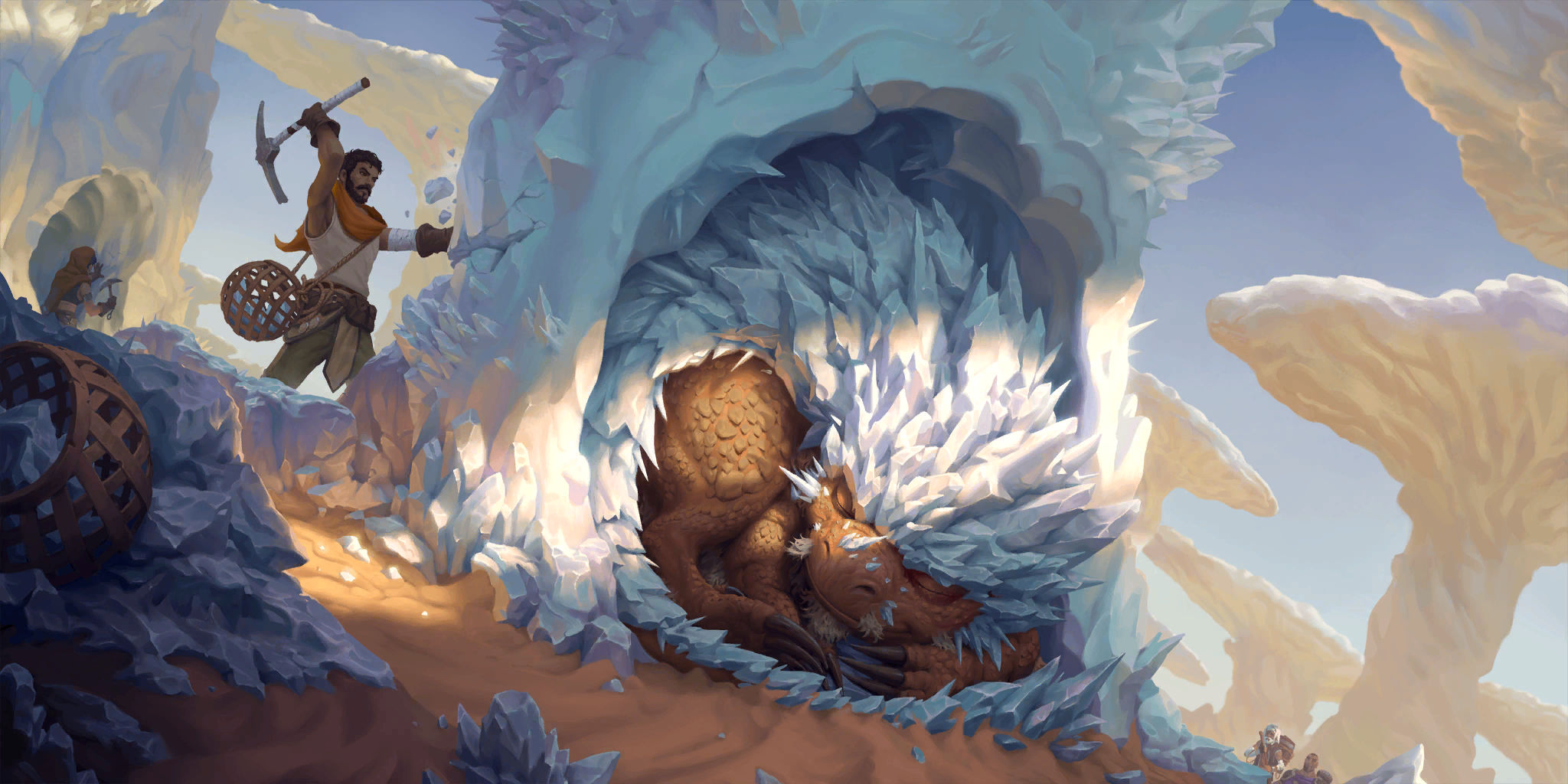
Now the thing you steer by. The Sun Disc of Shurima is the reason this whole region has a center. Our Atlas describes it as a colossal megastructure raised at the heart of the continent, a great disk that hovered above the capital city and let the Shurimans of old draw on raw celestial magic. Picture that from a rider’s seat: a disc of gold, lit like a second sun, hanging over the one city in a sea of sand.
That is the best landmark a big zone can own. You do not need a compass arrow when the objective is a glowing disc you can see from a day’s ride out. It sits high in the skybox, it never moves, and every road in the region bends toward it.

The disc has two states in our card set, and they map cleanly onto a live world’s before and after. Buried Sun Disc is the ruin you find, and Restored Sun Disc is what it becomes:
When Azir beheld the Shuriman capital’s Sun Disc, he saw it not for what it was, but what it could be, the key to returning Shurima to its former glory.
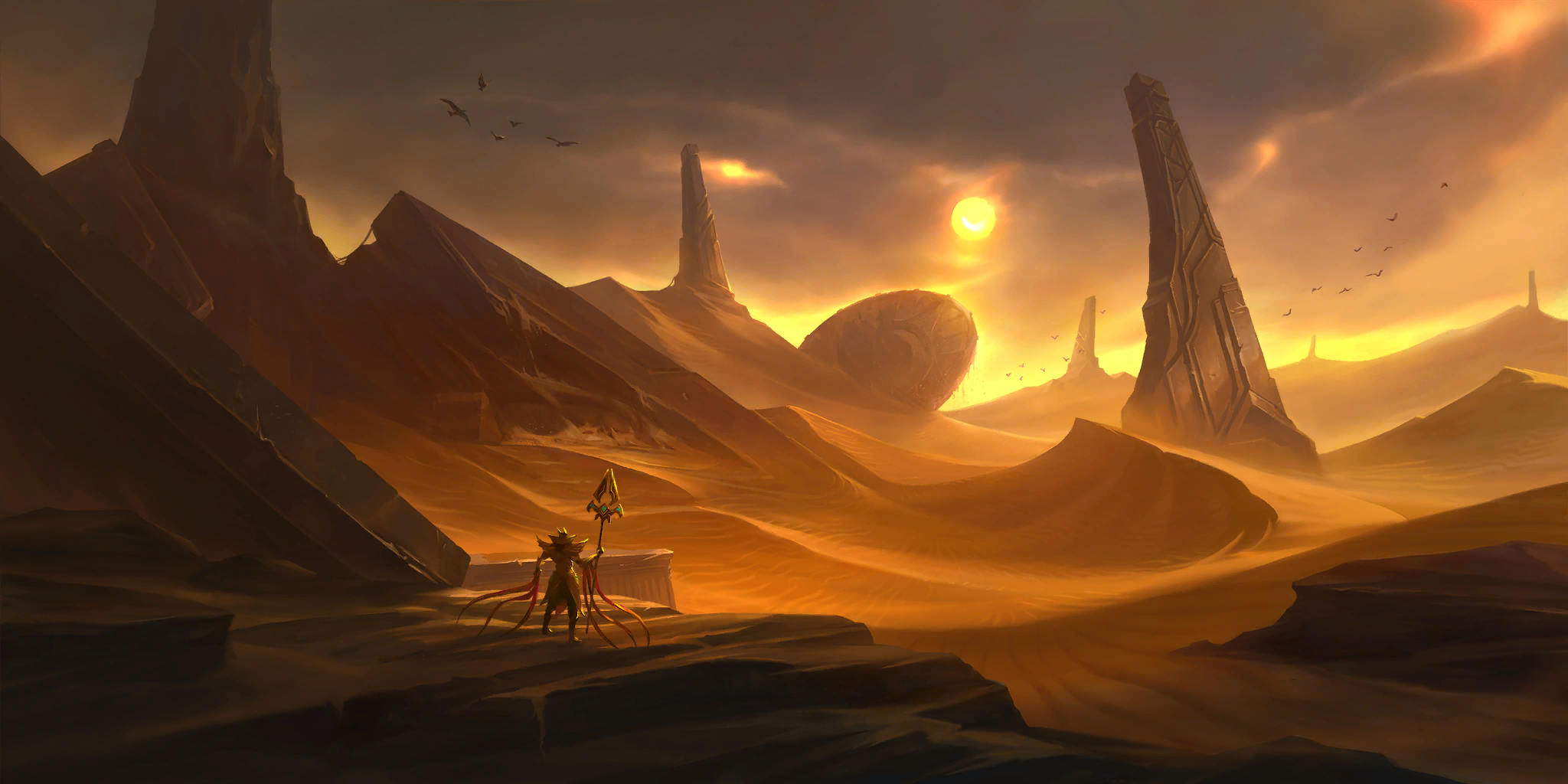

Everything that comes with the risen capital is drawn, too. The Emperor’s Army marches under a single conviction, and it doubles as a warning about who owns this landmark:
Azir knows Shurima as it was, is, and will be. He believes that his vision for the future is far more than a mere dream, it is a prophecy he is destined to fulfill.
Around it our Atlas hangs the rest of the skyline, the General’s Palace and the Altar of Blood, each a landmark tied to this one location record.


The Fastest Way Up Is to Stop Being Mortal
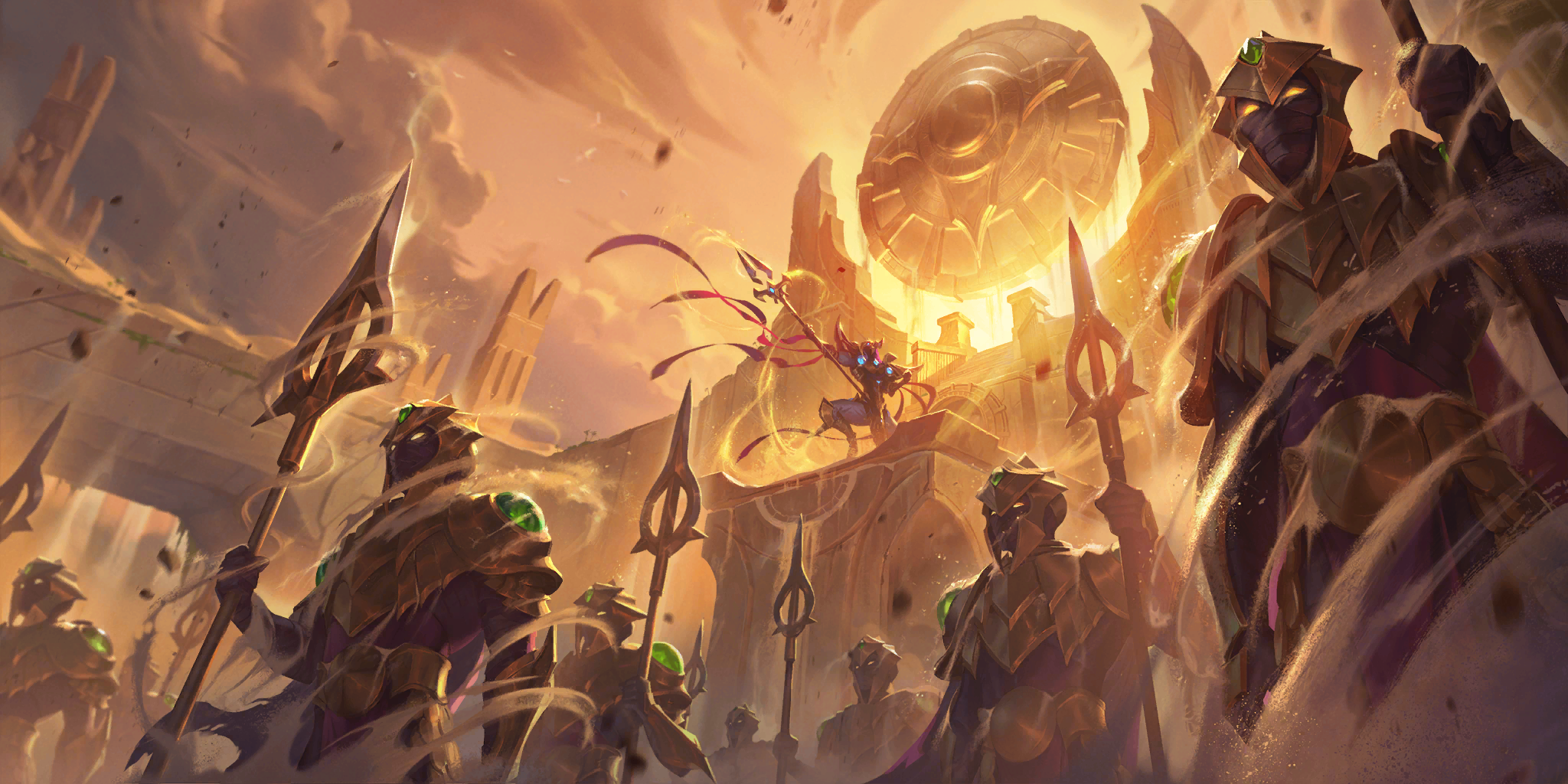
The Sun Disc is not scenery. Our Atlas calls it the instrument of Ascension, the primary mechanism by which Shurima’s god-warriors were made. It is a machine that lifts a worthy mortal into its light and brings down something else.
You can watch the machine run. In Shurima: Rise of the Ascended, Sivir lies betrayed and bleeding, and because she is the last in the bloodline of the lost emperor, her blood wakes it:
And as her blood soaks into the ancient sands, a deep magic sparks to life. Resurrection! First Azir’s mind, then his body. Snatched back from oblivion to be reborn.


The last shot of that cinematic is the payoff for this whole read: the disc restored, blazing over the risen city, the beacon and the machine in one frame.
Our encyclopedia is blunt about what the disc produces. The Ascended are, in its words, “mortals, once human, raised into towering, animal-headed god-warriors by the celestial power of Shurima’s Sun Disc.” The empire called them the Sunborn, and they were its living gods. Nasus kept the Great Library, his brother Renekton fought as one of its fiercest warriors, and the emperor Azir claimed the rite for himself before his advisor Xerath hijacked it and burned the golden age down in a single day. In traversal terms these are the beings that break the desert’s rules. They do not need a Dormun. Xerath is a storm of loose energy, Azir summons whole armies of sand warriors and raises buried temples at his command, and the tier as a whole reads as the region’s flight class. The reward at the top of the disc’s light is that you stop being bound to the ground.

Two of our cards catch the other half of Ascension, the part that outlives the god. Seal In Steel and Sunborn Summoning both file the same idea, that a god-warrior can be locked into an object and left in the world:
The fallen god-warriors entombed in these weapons could not be easily defeated, and so instead were contained.


Read those as content, not trivia. A desert seeded with sealed god-warriors in buried weapons is a to-do list. You travel to the artefact, and you decide whether the thing inside is a boss or a bargain.
There Is a Second Map, and It Points Up
Stacked on the ground layer is a second navigation system, and it points at the sky. Our encyclopedia says the disc was never really a Shuriman invention. In the Celestial entry, the Aspects of Targon set mortals to raise a great gleaming disc that channeled Aurelion Sol’s power to create immortal god-warriors. The Sun Disc is a Celestial machine that happens to sit in a desert.
Celestials are the setting’s travelers at the largest possible scale. Aurelion Sol crafted the stars that fill the night sky, Bard travels the harmonies between them, and Mount Targon is the bridge between the mortal and celestial realms. If Shurima’s ground layer is Dormun and sand, its sky layer is a star chart that the rest of Runeterra already reads by.
Their cards keep circling that one idea, that the stars are a map. Mountain Scryer says it out loud:
There is much to learn from the stars, from their guidance. For us, they are a constant, a way to chart our path.
Targon’s Peak stands as the gate to the Celestial Realm, its guardian named the great arbiter, and Aurelion Sol himself, chained and furious, is the engine the disc was built to tap. Here is the whole Celestial family our data ties to that sky:


The takeaway for a traversal read is that Shurima is where two of the biggest ideas in the setting meet at ground level. A rider steers by the disc. The disc steers by the stars.
Something Has to Live in the Empty Miles
One more layer, the smallest. A zone this big needs something alive in the parts with no city, no caravan, and no quest marker, or the space between waypoints reads as dead. Shurima’s answer is not a songbird in the ruins. It is a food chain, and for most of the map you are not the top of it.
The thing that hunts the open sand is the xer’sai. Our card set writes them as an ecology, not a monster of the week:
Once a caravan has been disabled, the hunters will occasionally retreat and allow their hatchlings to forage forward. It is here that the young xer’sai refine their instincts, learning which sounds are of the desert, and which signal their prey.

That is what makes travel here feel like travel: the miles between waypoints are somebody’s territory. Xer’sai Dunebreaker tunnels through solid bedrock to open new ground to hunt, and Unraveled Earth keeps the score:
As beautiful as the Great Sai may be, it is not a place for the weak. Many lives have been lost among its rolling dunes, and while the xer’sai claim many, the land itself takes its share.
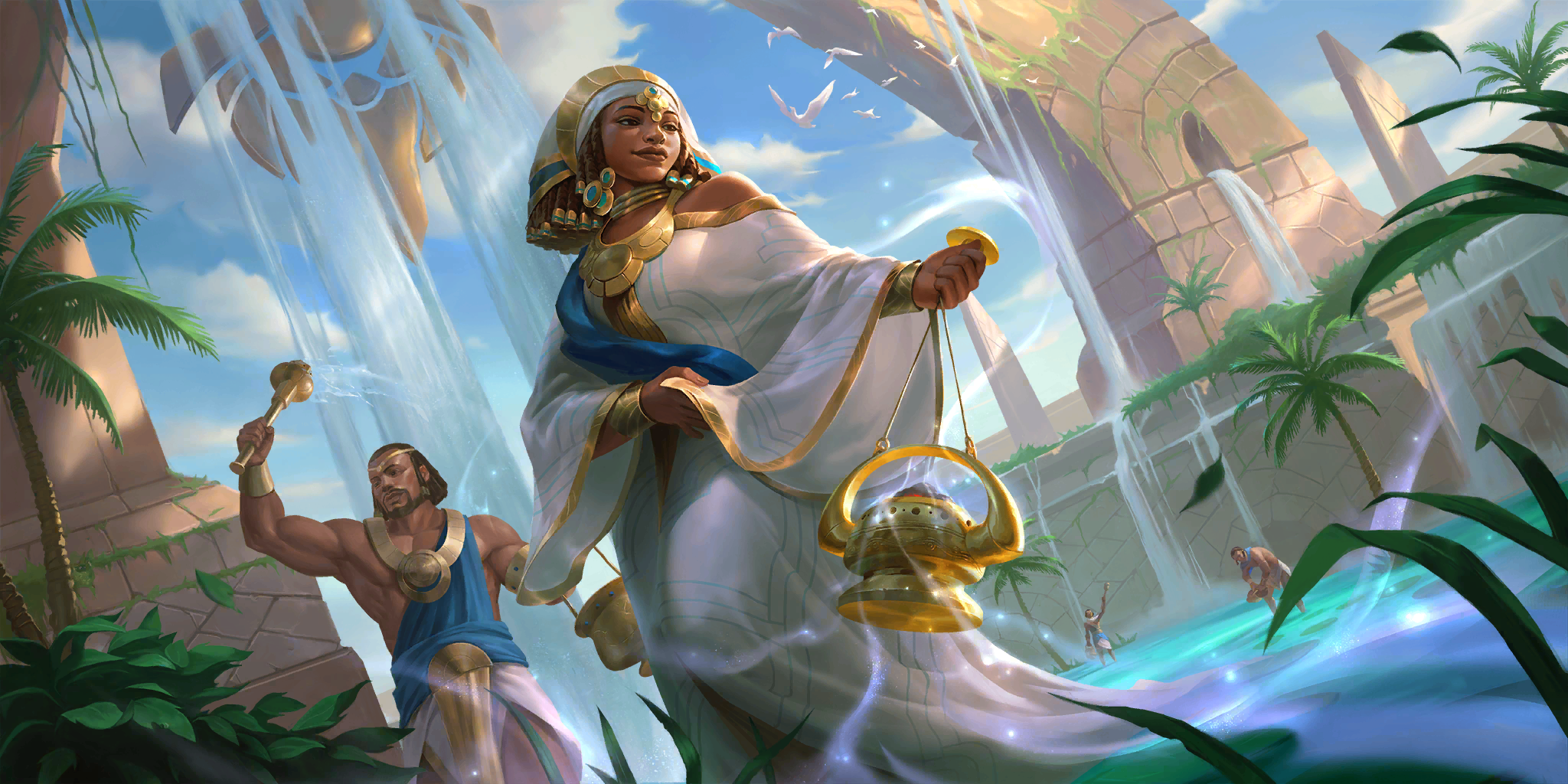
If the sand is the threat, the oasis is the mercy, and Shurima has that on a card too. The Soothsayer is the safe pocket in the middle of the killing ground, the rest stop an open world hangs its longest roads around:
Ah, you did not expect to see water in the middle of the desert. Worry not. Come, drink your fill, wash your feet. Rest in the shade awhile. This is Azir’s new Shurima, and it is an oasis.
Between the hunt and the water sits everything else the desert keeps: Sandstone Chimera, the rare beast of legend Shurimans caught sight of when Azir’s capital rose, and Quicksand, the hollows where old ruins have sunk and unwary travelers join them. Rare spawn, resource node, ambient predator, environmental hazard. That is a zone’s worth of open-world content, and Riot has already drawn all of it.


Would You Make the Crossing?
If Shurima shipped as a Riot MMO zone, would you spend the hours it takes to cross it on foot and by beast?
None of this is confirmed. Sources: our Atlas of Runeterra entry for the Sun Disc of Shurima, our Shurima region galleries, our Legends of Runeterra card database, and the Rise of the Ascended cinematic, all built from Riot’s own canon. Analysis by RuneGrove.


